
How to
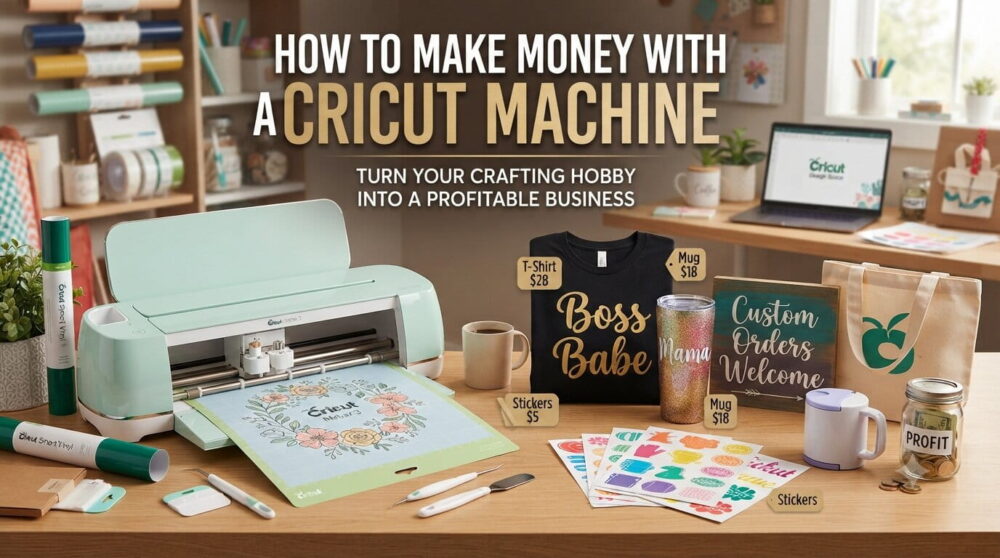
How to make money with Cricut – Cricut Cash Cow Blueprint
Jul
Your Cricut Isn’t a Hobby Machine Anymore — It’s a Business You Haven’t Started Yet
There’s a specific kind of guilt that comes with owning a Cricut.
You saved up for it. You watched the tutorials. Maybe you made a few tumblers, some birthday banners, a couple of shirts for the kids’ sports team. And then… it sat there. Not because you lost interest — because somewhere between “this is fun” and “this could actually make me money,” you hit a wall nobody warned you about.
The wall isn’t your skill. It’s not your machine. It’s the plan.
The Real Problem Isn’t Your Cricut — It’s the Missing Roadmap
Scroll through any Cricut Facebook group and you’ll see the same question asked a thousand different ways: *”How do I actually start selling this stuff?”*
The answers are always the same scattered mess — “just list it on Etsy,” “try craft fairs,” “make cute stuff people want.” None of that is wrong, exactly. It’s just useless. It’s the business equivalent of telling someone who wants to lose weight to “eat less and move more.” True, but it doesn’t tell you what to actually *do* on Tuesday.
This is the exact gap that keeps thousands of capable, creative Cricut owners stuck in the same place: machine on the desk, ideas in their head, and zero dollars in their pocket. Not because they can’t make things — because nobody ever handed them a system. What to make. Where to sell it. What to charge. What to say to a buyer who’s on the fence. What to do in week one versus week three.
Without that structure, “I could probably sell this” quietly turns into a craft room full of unsold tumblers and a Cricut that mostly makes birthday cards now.
## Why “Just Start” Advice Doesn’t Work
Here’s the thing that trips up most hobbyists trying to go pro: they think the hard part is the *making*. It’s not. You already know how to run your machine. The hard part is everything around the making — the business decisions nobody teaches you.
Three questions stop almost everyone before they get to their first sale:
“What do I actually make that people will pay for?” Not every cute idea is a sellable product. There’s a real difference between a fun craft and an income stream, and most people can’t tell which is which until they’ve already wasted weeks on the wrong one.
“What do I charge?” This is where the guilt spiral really kicks in. Price too low and you’re working for pennies an hour, resenting a business you used to love. Price too high with no confidence behind the number, and you second-guess every listing until you just… don’t post it.
“Where do I even put this so someone will buy it?” Etsy, Amazon Handmade, Pinterest, local businesses, craft fairs — each one has completely different rules for what sells, and guessing wrong wastes months.
Answer those three questions with a real plan instead of a shrug, and the entire equation changes.
What Actually Fixes This
That’s exactly the gap the Cricut Cash Cow Blueprint was built to close.
It’s a 32-page, plug-and-play business system — not another Pinterest board of “cute ideas you should try.” It hands you nine complete, proven income streams (personalized items, custom stickers, 3D shadow boxes, branded merch for local businesses, classroom materials, greeting cards, party decor, print-on-demand, and product bundling), and for each one it spells out exactly what to make, where to sell it, and what to charge.
It also solves the three questions above directly:
– The pricing problem gets solved with a pricing formula built to protect your profit, so you stop guessing at numbers and start charging what your time is actually worth.
– **The “where do I sell this” problem** gets solved with a full platform breakdown covering Etsy, Amazon Handmade, local direct sales, Pinterest, and craft fairs — with specifics on how to actually win on each one, not just a list of options.
– The “what do I even say” problem gets solved with word-for-word scripts for Etsy listings, Facebook posts, reaching out to local businesses, and asking for reviews. You’re not staring at a blank text box wondering how to sound professional — you’re copying, pasting, and adjusting.
Then it ties the whole thing together with a 5-step launch checklist to get you to your first sale this week, and a 30-day, week-by-week roadmap so you always know what today’s task is instead of relearning your whole strategy every Monday.
## The First Sale Doesn’t Come From Reading — It Comes From a Plan You Can Actually Follow
Here’s the honest truth buried in all of this: no guide, however good, makes the product for you. What it *can* do is remove every excuse standing between “I have a Cricut” and “I have a business.”
Pick one stream. Make one product. List it this week. That’s the whole ask. The Cricut Cash Cow Blueprint exists so that when you sit down to actually do that, you’re not guessing — you already know what to make, what it’s worth, where it goes, and what to say when someone’s interested.
It’s an instant digital download, and no prior business experience is needed. If your Cricut has been quietly judging you from the craft table, this is the plan that finally gets it earning instead of collecting dust.
Get the Cricut Cash Cow Blueprint
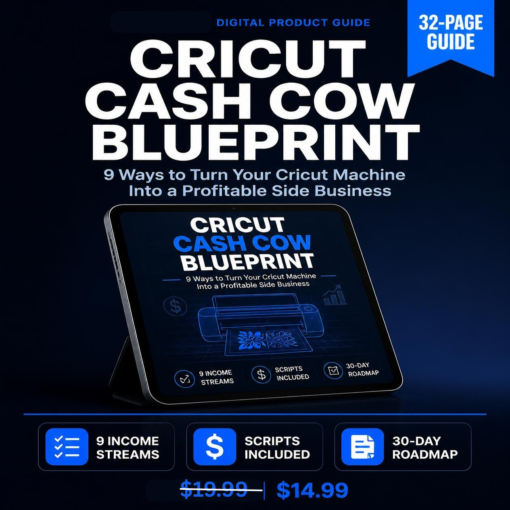
Cricut Cash Cow Blueprint- Turn Your Cricut Machine Into a Profitable Side Business
Turn your Cricut into real income. This 32-page guide gives you 9 proven income streams, a pricing formula, word-for-word sales scripts, and a 30-day roadmap — everything you need to go from hobby to your first sale this week.